
ARTICLE AD BOX
UK goods exports to US fall to three-year low
The UK GDP figures also showed some of the damage done by Donald Trump’s tariffs: goods exports to the US slumped by 13.5% in the second quarter compared with the same period a year earlier.
The British Chambers of Commerce (BCC) said it was the lowest UK exports to the US in three years, when trade was heavily disrupted by the coronavirus pandemic.
The start of the second quarter – 2 April, to be precise – will go down in economic history after the US revealed its “liberation day” tariffs. That sparked financial market chaos, and huge real-world disruption as exporters to the US tried to work out whether it was possible to continue sending products to the world’s biggest consumer market.
William Bain, head of trade policy at the BCC, said:
Tariff effects are clearly being felt by companies exporting to the US. Total goods exports across the Atlantic for the second quarter 2025 were 13.5% lower than a year ago. But the UK’s performance is not all bleak, with strong services exports across the second quarter.
This was the first full quarter of the ‘reciprocal’ US tariffs, which add an extra 10% to most UK sectors, from food and drink to chemicals. The effect of these higher costs is becoming clear, with the lowest levels of goods exports to the US for three years.
Implementation of the UK’s trade deal with the US in full is now needed to improve prospects, particularly for steel and aluminium goods. The agreement should be a platform to discuss further tariff reform with the US, especially in goods sectors where there is little competition on production.
Key events Show key events only Please turn on JavaScript to use this feature
Closing summary: Strong data in UK and US suggest later interest rate cuts
The UK economy grew by 0.3% in the second quarter of 2025, the Office for National Statistics said.
That was higher than the 0.1% expected by economists polled by Reuters, and may mean the Bank of England holds off on cutting interest rates until next year, according to some economists.
The increase came despite UK goods exports to the US slumping by 13.5% in the second quarter compared with the same period a year earlier, as the effects of Donald Trump’s tariffs became clearer. The British Chambers of Commerce (BCC) said it was the lowest UK exports to the US in three years, when trade was heavily disrupted by the coronavirus pandemic.
The UK was not the only country to report “hot” data that will give central banks pause before cutting interest rates. In the US producer price index inflation surged in July, up 0.9% in the month, and 3.3% higher than a year earlier, according to data published on Thursday by the Bureau of Labor Statistics.
Traders pulled back on bets of a bigger cut than usual – of half a percentage point – at the Federal Reserve’s next meeting in September. Reuters reported:
The dollar index gained 0.2% from an over two-week low […] while benchmark 10-year yields edged up from a one-week low.
Stronger US wholesale price data tempered bets on a larger, half-point cut next month. Traders are now leaning toward a quarter-point move with another in October, reinforcing comments from Fed’s Mary Daly that such a large cut is not needed.
In other business and economics news today:
-
Admiral Group shares jumped 5% profit before tax rose by 69% to £521m, as it shrugged off falling car insurance prices.
-
Aviva’s share price jumped after the insurer also reported strong earnings for the first half of 2025 and said its integration of Direct Line was going well.
-
Claims of an exodus of wealthy “non-doms” in response to tax rises may be overblown, according to a report that suggests the number leaving the country is in line with official forecasts.
-
Industrial production fell by 1.3% in the eurozone in the year to June, according to figures published by Eurostat.
-
Short sellers are betting that baked goods chain Greggs has reached its peak.
-
National Grid has agreed a £1.7bn deal to sell its Grain LNG business to British Gas owner Centrica and US private equity group Bridgepoint.
You can continue to follow our live coverage from around the world:
Thank you for joining me today, and please do tune in tomorrow when Lauren Almeida will be in the hot seat. JJ
Wall Street has followed the lead of the FTSE 100, falling at the opening bell. (NB, other European indices are so far in the black today).
Here are the opening US stock market index snaps, via Reuters:
-
S&P 500 DOWN 19.56 POINTS, OR 0.30%, AT 6,447.02
-
NASDAQ DOWN 73.80 POINTS, OR 0.34%, AT 21,639.34
-
DOW JONES DOWN 198.80 POINTS, OR 0.44%, AT 44,723.47
That inflation data may well have had something to do with it: if inflationary pressure builds, then the Federal Reserve is less likely to cut interest rates – whatever Donald Trump may believe.
How much should the Federal Reserve be worried that wholesale price rises mean the US is in for a bout of inflation heat?
“Price pressures are building, but July’s data overstate the intensity”, said Samuel Tombs, chief US economist at Pantheon Macroeconomics, a consultancy. The Fed looks particularly carefully at the core personal consumption expenditure index as a key measure of inflationary pressure in the US economy. Not all of the producer price index inflation will feed through, Tombs said.
In a note to clients, he wrote:
The surge in producer prices has limited implications for the July core PCE deflator, but indicates that the new tariffs are continuing to generate cost pressures in the supply chain, which consumers will shoulder soon.
The outlook remains for a steady climb in core PCE inflation towards a peak of about 3.25% at the end of this year, despite the surge in producer prices.
US wholesale prices surged in July, raising inflation concerns
US wholesale price inflation surged in July, according to new data that will bolster the Federal Reserve governors who have held interest rates steady despite intense pressure from Donald Trump to cut.
The producer price index (PPI) rose by 0.9% in July, according to the under-pressure Bureau of Labor Statistics (BLS). That was far above the 0.2% expected by economists polled by Reuters.
The reading will ring alarm bells for economists watching for signs of inflationary pressure in the US economy. The Fed has cited inflationary concerns as a reason to leave interest rates on hold.
Tariffs are expected to raise costs for businesses importing materials to produce products within the US. That is expected to pass through to the broader economy.
Although Trump is perhaps unlikely to engage with the details of inflation, the data comes at a sensitive time for the BLS. Trump fired its head, Erika McEntarfer, earlier this month following the release of a weak jobs report which he claimed, without evidence, had been “rigged”.
He has since hired a right-wing economist, EJ Antoni, who has been critical of the BLS to supposedly correct the data.

Lauren Almeida
Claims of an exodus of wealthy “non-doms” in response to tax rises may be overblown, according to a report that suggests the number leaving the country is in line with official forecasts.
In April the chancellor, Rachel Reeves, scrapped the non-domiciled tax status, which allowed wealthy individuals with connections abroad to avoid paying full UK tax on their overseas earnings.
Since then a wave of reports has suggested that changes to the status and other tax policies are triggering an exodus of high net worth individuals.
However, early monthly payroll data from HM Revenue and Customs appears to indicate that the number of non-dom departures is in line with official predictions, according to sources cited by the Financial Times.
The Office for Budget Responsibility (OBR) forecast in January that 25% of non-doms with trusts would leave the UK in response to the abolition of the tax status, while 10% of those without trusts would leave. Official data suggests this prediction was broadly correct, people briefed on the findings told the FT.
You can read the full story here:

It is not just companies outside the US that have been hit hard by Trump’s tariffs: tractor maker Deere is the latest company to detail the financial hit, with a big drop in its profit forecast.
The maker of the John Deere brand cut the top end of its forecast for net income for the 2025 financial year from $5.5bn to $5.25bn, a $250m cut.
The Illinois-based company had previously said that tariffs would cost it $500m (£368m).

Kalyeena Makortoff

Aviva’s chief executive, Amanda Blanc, has reiterated the insurer’s commitment to climate goals in the face of growing pushback against net zero ambitions in the US and UK.
Her comments came as Aviva’s shares on Thursday hit their highest level since the 2008 financial crisis, with investors cheering a rise in profits, and fresh payouts for investors, worth 13.1p a share.
Blanc told journalists that the insurer was not wavering on climate transition plans, which she said were an important step in responding to a further rise in extreme weather events affecting its insurance business. She said on Thursday:
We remain committed to our ambition. It’s also an important priority for many of our clients, but I would always put this into the context of extreme weather conditions, climate change and the impact that that has on our insurance business that actually insures properties.
You can read the full story here:
US finally gives draft statement on EU trade deal

Lisa O’Carroll
The US has finally produced a draft of the joint statement sealing the trade deal with the EU agreed at Donald Trump’s golf course in Scotland on 27 July.
The joint statement is not legally binding and has been described by the EU as a “road map” for future negotiations on potential reductions of tariffs on sectors such as steel, wines and spirits and some agriculture products. EU spokesperson Olof Gill said:
We have received a text from the US with their suggestions for getting closer to that finalisation of the document.
We are going to make our suggestions back, we will ping pong it forward and back until we get to a final text and I hope we can get there soon.
The EU struck a deal with the US which will see 15% tariffs on imports from the bloc but – unlike other countries including the UK – these tariffs, uniquely, will not be “stacked” on top of existing tariffs.
An average tariff of 4.8% applied to EU imports before Trump came into power with a 3.7% applying in the UK. The latest deals mean on average the UK and EU tariffs are not so far apart, at 15% and 13.7% on average.
However, the EU is still hit by punitive steel tariffs, currently at 50% compared to the UK where the older 25% tariff applies.
Three months after Trump struck his deal with the UK, however, there is still no sign of delivery on the US commitment to slashing tariffs to zero as part of the 7 May deal.
UK goods exports to US fall to three-year low
The UK GDP figures also showed some of the damage done by Donald Trump’s tariffs: goods exports to the US slumped by 13.5% in the second quarter compared with the same period a year earlier.
The British Chambers of Commerce (BCC) said it was the lowest UK exports to the US in three years, when trade was heavily disrupted by the coronavirus pandemic.
The start of the second quarter – 2 April, to be precise – will go down in economic history after the US revealed its “liberation day” tariffs. That sparked financial market chaos, and huge real-world disruption as exporters to the US tried to work out whether it was possible to continue sending products to the world’s biggest consumer market.
William Bain, head of trade policy at the BCC, said:
Tariff effects are clearly being felt by companies exporting to the US. Total goods exports across the Atlantic for the second quarter 2025 were 13.5% lower than a year ago. But the UK’s performance is not all bleak, with strong services exports across the second quarter.
This was the first full quarter of the ‘reciprocal’ US tariffs, which add an extra 10% to most UK sectors, from food and drink to chemicals. The effect of these higher costs is becoming clear, with the lowest levels of goods exports to the US for three years.
Implementation of the UK’s trade deal with the US in full is now needed to improve prospects, particularly for steel and aluminium goods. The agreement should be a platform to discuss further tariff reform with the US, especially in goods sectors where there is little competition on production.
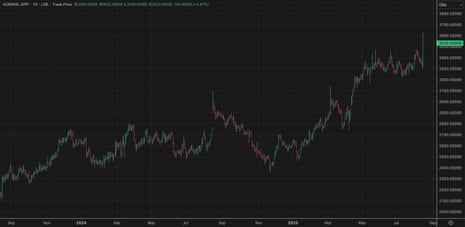
Aviva is not the only FTSE 100 insurer beginning with A doing well today: Admiral Group has jumped 5% after a surge in profits – making it the top riser on London’s top index.
The company reported profit before tax up by 69% to £521m, as it shrugged off falling car insurance prices.
Admiral’s share price hit a record £36.32 in trading on Thursday morning.
Milena Mondini de Focatiis, group chief executive officer, said:
We have delivered another excellent first half with strong execution across all strategic objectives. Group profit increased 69% to a record £521m. We have an additional one million customers across our diversified businesses compared to this time last year, due to our focus on offering competitively priced cover and excellent service across our diversified businesses.
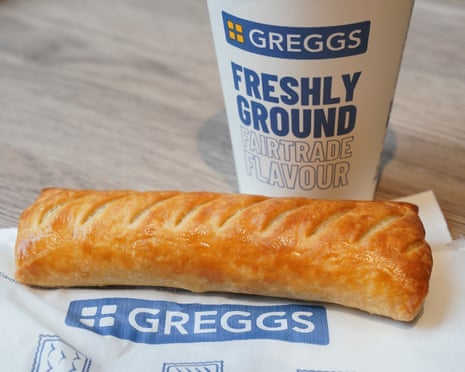
Bad news for lovers of sausage rolls (vegan or otherwise): bosses at Greggs may not believe the UK has reached “peak Greggs”, but short sellers beg to differ.
Data spotted by Bloomberg showed that positions likely to indicate short sellers were at the highest since the financial crisis. It reported:
Greggs stock out on loan — an indication of short interest — reached 9% of shares outstanding as of Tuesday, according to data from S&P Global Market Intelligence. That’s the highest since March 2008, with the bulk of this year’s activity occurring in the past four months.
Short sellers borrow shares from other companies (for a small fee). They then sell those shares, and hope that the price falls before they buy them back. If the price has fallen then they pocket the difference – although if the price rises then there is no actual limit on their losses.
But short sellers think that it will struggle after rapid expansion. From last month’s Guardian report:
Greggs, which operates 2,649 shops across the UK, notched up more than £1bn in sales in the first six months of the year for the first time, but its profits fell as it battled rising costs, lower footfall and more weather disruption than in 2024.
The Financial Conduct Authority’s data showed that JP Morgan Asset Management held the biggest short position, equivalent to 1% of Greggs’s shares. BlackRock Investment Management, ExodusPoint and GLG were the other asset managers with positions worth more than 0.5% of the company that they had to disclose.

The size of the boom in artificial intelligence spending is fairly astonishing: the Financial Times reported that Google, Amazon, Microsoft and Meta will spend more than $400bn on capital expenditure in 2026 — on top of more than $350bn this year. That compares with less than $100bn (still a staggering sum) in 2020.
And the old adage about shovel makers in a gold rush appears to be playing out. Taiwan’s Foxconn is famous for making the Apple iPhone, but work making servers for chip designer Nvidia has surpassed that, the company said on Thursday.
Reuters reported:
Foxconn expects higher third-quarter revenue, it said on Thursday, on robust demand for artificial intelligence servers, which helped the world’s largest contract electronics maker report a forecast-beating 27% increase in second-quarter profit.
Those servers are then sold by Nvidia to the companies racing to win the artificial intelligence battle by investing in the most computing power. The big tech companies hope that more “compute” will allow them to dominate the sector (although they could be left holding the world’s most expensive bag if cheaper models come along and match their performance).
Europe’s economy is showing “fading industrial resilience and stark divergence across the eurozone”, said Carsten Brzeski, global head of macro at ING, an investment bank.
He wrote in a note to clients:
Industrial production plunged by 1.3% month-on-month in June, from +1.1% in May. On the year, eurozone industrial production was only marginally up. With today’s data, the strong surge in the first quarter due to the US front-loading of eurozone goods ahead of higher tariffs has basically been reversed entirely.
While tariffs and the stronger euro will continue to weigh on the manufacturing sector, the gradual cyclical turning of the inventory cycle as well as the structural shift towards defence should support growth ahead.
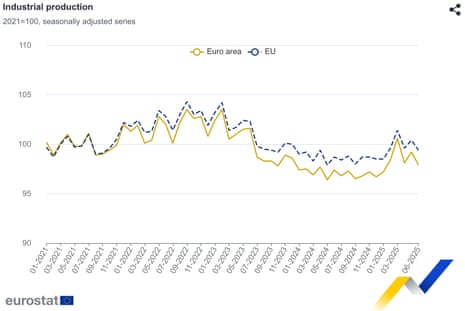
Eurozone industrial production slumps
Eurozone GDP’s second reading came in as expected at 0.1% quarter-on-quarter for the second quarter – weak, but not a surprise. However, there were some worrying signs from industrial production data.
Industrial production fell by 1.3% in the eurozone in the year to June, according to figures published by Eurostat. That was an acceleration in the rate of decline from May, and worse than the 1% drop expected by economists polled by Reuters.
Companies raced to produce goods and ship them to the US in the first quarter of 2025 – providing a short-lived boost to economic output – but that looks to have unwound during the second quarter, as the tariffs were actually implemented. European factory output has since fallen back.
Carmakers in particular were badly hit, with a 15% rate agreed last month, after an initial rate of 27.5% on car exports to the US.
However, Matt Swannell, chief economic advisor to the EY ITEM Club, a forecaster, said that “the underlying picture for the UK is one of continued sluggish growth”.
He said:
This largely reflects the strength of domestic headwinds, including a significant tightening in fiscal policy and the lagged impact of past interest rate rises. US tariff announcements will also drag on the near-term growth outlook.



 English (US) ·